


Showing posts with label Microcontroller. Show all posts
Showing posts with label Microcontroller. Show all posts
17.3.17
9.2.14
Hacked Wall Clock (after Lord Vetinari)
This clock ticks erratically but still keeps accurate time. Its mechanism has been replaced by a programmable chip that emits 64 randomly spaced ticks every 64 seconds.
31.12.13
Magic Mote Thermostat and Wireless Temperature Sensor
A homemade thermostat up in the basement rafters controls the heating in my home. The smart bit is the radio frequency communication that connects it to a remote temperature sensor.

Magic Mote Wireless Sensor Node
This compact PCB interfaces a low power MSP430G2553 microcontroller with a Nordic NRF24L01+ 2.4 GHz radio frequency transceiver module. It's well adapted to serve as a wireless sensor node, but has enough I/O options to be put to use wherever a small microcontroller is required. PCBs now available from Tindie!

4.12.13
Homemade MSP430 Launchpads
When I ordered some NRF24L01+ boosterpacks from the 43oh store, I asked for a couple of MSP430 Launchpad v1.4 PCBs. These are legacy boards kindly provided by TI (thanks LariSan!) It was fiddly soldering to the tiny 0402 pads since my components were all 0805. The LEDs were especially tricky. But they both turned out OK as you can see. Here they are (alongside a genuine Launchpad on the left) running the breathing LED demo from the OSX Launchpad toolchain.


5.11.13
Stripboard PID Arduino Shield, Part 3: Serial Interface
The graphical user interface allows every feature of the Arduino PID controller shield to be governed remotely via the serial interface. A powerful additional feature is the ability to set multi-stage temperature profiles for applications where the set point changes over time.

in
Arduino,
Electronics,
Microcontroller,
PCB,
PID,
Project,
Software,
SSR,
Temperature,
Tricky
4 comments


Stripboard PID Arduino Shield, Part 2: Firmware
Install the code base for the stripboard Arduino PID shield and get started using it as a standalone temperature controller.

in
Arduino,
Electronics,
Food,
Microcontroller,
PCB,
PID,
Project,
SSR,
Temperature,
Tricky
41 comments
Stripboard PID Arduino Shield, Part 1: Hardware
This easy-to-make shield converts your Arduino into a full-featured PID controller.


in
Arduino,
DangPro,
DIY,
Electronics,
Microcontroller,
PCB,
PID,
Project,
PyroElectro,
SSR,
Temperature,
Tricky
4 comments
29.10.13
Jack-O'-Launchpad
Perhaps not the most imaginative used of a Tiva Launchpad, but the default application makes for a serviceable Jack-O'-Lantern. Powered by a USB adapter from CUI, a freebie via @digikey on twitter. Nice!

in
DangPro,
Freebie,
Halloween,
Launchpad,
Microcontroller,
Power supply,
TI,
Tiva,
Toy,
USB
No comments
24.8.13
I2C LED Display From Hacked Voltmeter
LED voltmeters are a cheap source of 7 segment displays and can easily be repurposed. Using the I2C protocol, a master microcontroller such as an Arduino Uno can govern multiple displays with just 2 I/O pins.


in
Arduino,
Blinky,
Cheap,
DangPro,
Electronics,
Hack-A-Day,
I2C,
Microcontroller,
PCB,
Project,
STM8S,
Tricky
15 comments
23.2.13
@YT2095 Magic Mouth v1.0 Build
Yours Truly (@YT2095) is putting together a Magic Mouth v1.0 speech synthesis shield for his Saturday morning project! Just for fun, I sent him one the PCBs I had got back from Seeedstudio's FusionPCB service. He's substituted a potentiometer for the thumbwheel trimmer, and it looks like one last header and the jack socket still need to make it onto the board. It's looking good, John. :)

11.12.12
Home Made Arduinos
Making Arduinos was pretty laborious. The toner transfer went well, but drilling was a dental experience.


1.12.12
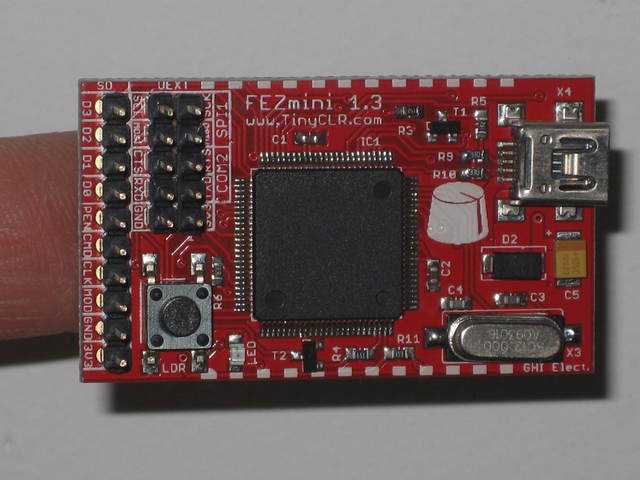
December Swag Bag: FEZmini
The FEZ mini runs .NET, can act as a USB host with minimal adaptation, and balances on the end of a finger. Tip of the small, brimless hat to Seeed Studio.
28.11.12
Magic Mouth: Arduino Speech Shield
Ready to talk the talk? Give your Arduino the power of speech. This easy-to-build circuit includes a voice synthesizer and amplifier.

3.11.12
Old MacDonald Hacked A Farm
My kids have a plastic farm toy. It neighs, it baas, and frankly, it grates. But since I tricked it out with a microcontroller brain, at least it can play Simon.
2.10.12
Twirly Webcam
Reaching forward to adjust the webcam got old. Technology came to the rescue in the form of a webcam that pans around the room under the control of a paddle or foot pedal.
30.9.12
Hacked Whammy Pedal
I bought a toy foot pedal for $10. I didn't know how to communicate with it, but for some reason that didn't bother me until I had it in my hands and was wondering what to do with it.


21.9.12
Quacking Oven Timer
The kitchen stove had no timer. Hannah had grown out of the waterfowl-themed slippers that she had been given. What came next? A schlock quack duck cook clock hack.
in
Clock,
Electronics,
Food,
Hack-A-Day,
Microcontroller,
MSP430,
Noisy,
Project,
Toy,
Tricky
No comments
Subscribe to:
Posts (Atom)